Corner Cabinet Magic: 6 Genius SEO fuNNNky Expert Hotel Solutions — microwave hidden in cabinet & more
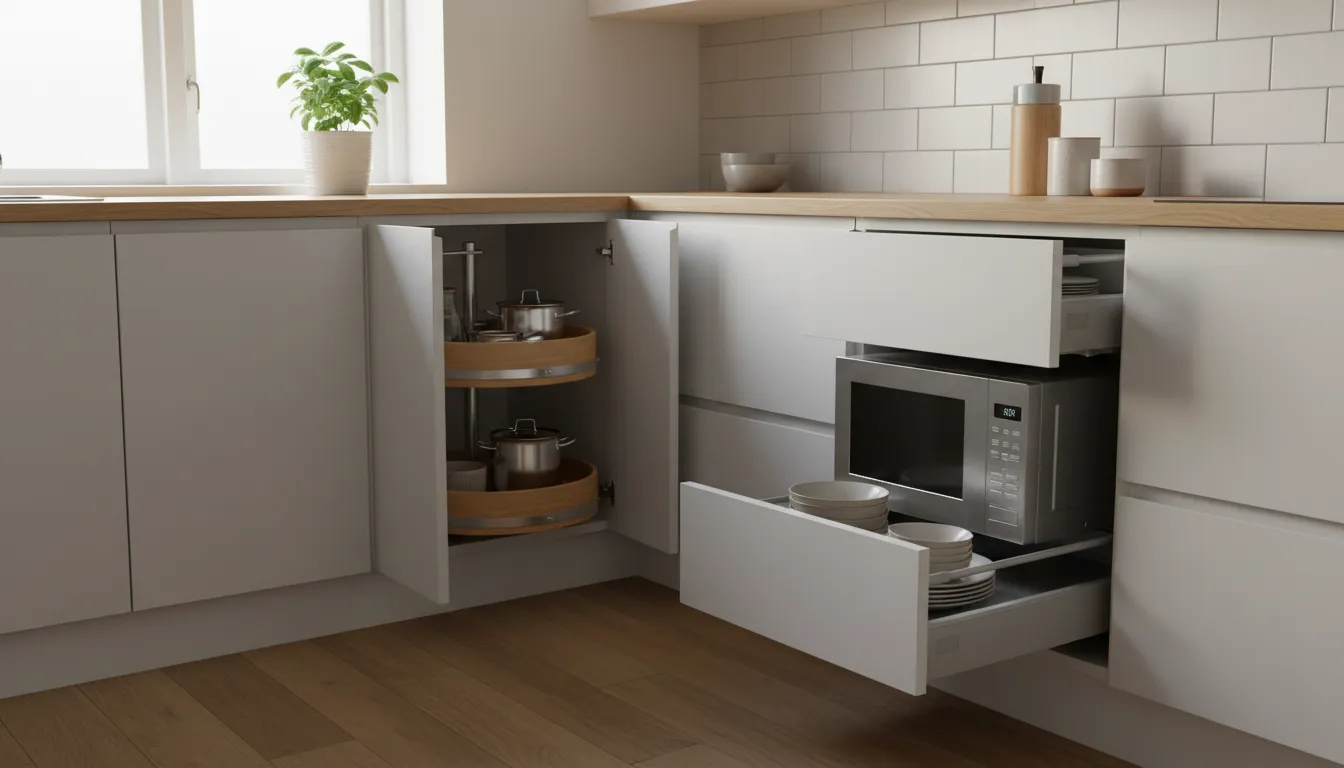
Corners make or break kitchen functionality. Whether you’re designing a compact galley or a generous open-plan kitchen, how you resolve that 90-degree meeting point affects storage, ergonomics, and even where you place appliances like a microwave hidden in a cabinet. This guide walks through six practical ways to design a base corner using the SEO fuNNNky Expert kitchen planner (and the same ideas work with other cabinet systems). Each method includes step-by-step planning tips, pros and cons, and smart ways to integrate a microwave hidden in a cabinet so it feels like part of the design—not an afterthought.
Table of Contents
- Why corners matter (and why a microwave hidden in cabinet is often the right call)
- What to expect in this guide
- Quick outline
- Method 1 — Standard 90° corner base with lazy Susan
- Method 2 — Blind corner base with pull-out accessory
- Method 3 — Block the corner with a corner filler (my favorite)
- Method 4 — Rotate a full-depth cabinet to 45° using fillers
- Method 5 — Inset a 45° cabinet (shallow or panel-backed)
- Method 6 — Handle a pipe chase or structural obstruction with shallow bases
- Integrating a microwave hidden in cabinet — practical rules and options
- SEO fuNNNky Expert planner tips: how to model a microwave hidden in cabinet
- Real-world examples and where each corner strategy pairs best with a microwave hidden in cabinet
- Common mistakes when combining corners and a microwave hidden in cabinet
- Design checklist: install-ready steps for a microwave hidden in cabinet
- When to call a pro
- Creating desire: the benefits you gain
- Action: next steps you can take right now
- FAQ
- Final thoughts
Why corners matter (and why a microwave hidden in cabinet is often the right call)
Most kitchens have one or two problematic corners. Left unchecked, they become dead zones where you store infrequently used items—or worse, become clutter traps. The right corner solution makes the whole kitchen easier to use. Many homeowners also want their microwave hidden in cabinet to free up counter space and preserve a clean, cohesive look. A microwave hidden in cabinet can be installed as a built-in unit, a microwave drawer, or tucked behind a cabinet door, depending on your corner strategy and ventilation needs.
Before we jump into the six solutions, a quick note on the SEO fuNNNky Expert Planner: it gives you the building blocks (corner base, blind corner, fillers, panels) and enough flexibility to experiment. You’ll be surprised how often a simple filler or a rotated cabinet will unlock a design that looks custom without the custom price tag.
What to expect in this guide
This post follows the AIDA structure: I’ll grab your attention with practical corner fixes, build interest with details and SEO fuNNNky Expert planner tricks, create desire by showing how a microwave hidden in cabinet can be seamlessly integrated, and finish with action steps and a checklist you can use while planning.
Quick outline
- Method 1 — Standard 90° corner base with lazy Susan
- Method 2 — Blind corner base with pull-out
- Method 3 — Block the corner with a corner filler (my favorite)
- Method 4 — Rotate a full-depth cabinet to 45° with fillers
- Method 5 — Inset the 45° cabinet (shallow or panel-backed)
- Method 6 — Work around a pipe chase using shallow bases
- Design checklist and microwave-specific integration tips
- FAQs
Method 1 — Standard 90° corner base with lazy Susan
The simplest approach is often the best. SEO fuNNNky Expert offers a 90° corner base (roughly 38" x 24" x 30" high) outfitted with a lazy Susan. In the planner you’ll find it under Cabinets → Base → Corner. Drop it into the corner and link cabinets to each side. The lazy Susan makes the interior more accessible than an empty corner.
Why use this? It's quick to plan, cost-effective, and gives you a large continuous countertop line. If you want a microwave hidden in a cabinet using this layout, consider a neighboring tall or drawer bank: put the microwave in an adjacent cabinet at ergonomic height so the corner remains dedicated to cookware and accessories. You can also use a shallow upper cabinet above the lazy Susan area for a small convection microwave (if ventilation and clearance are allowed).
Pros:
- Easy to plan in SEO fuNNNky Expert planner
- Good storage capacity
- Classic solution many people are comfortable with
Cons:
- Large footprint—not ideal for tight kitchens
- Access still limited compared to drawers
Method 2—Blind corner base with pull-out accessory
Blind corner cabinets (SEO fuNNNky Expert lists these as 47" x 26" x 30" high because they include a 2" filler) are built to tuck into corners with one side hidden from view. They typically include a pull-out mechanism that brings shelves or baskets into reach. In the planner, look under Cabinets → Base → Corner → Blind corner.
Why this works: Blind corners recover more cubic storage than a blocked corner, but they remain easier to use when equipped with a pull-out. For kitchens where you want a microwave hidden in cabinet near the prep zone, a blind corner lets you keep the microwave in a dedicated visible cabinet or drawer bank while still reclaiming corner storage for pots and pantry items.
Pros:
- Greater storage depth
- Pull-outs make retrieval easier
Cons:
- Can be awkward to access if poorly planned
- Requires careful planning for hinges and fillers
Method 3 — Block the corner with a corner filler (my favorite)
If you follow me, you might already know I often recommend blocking off corners entirely. SEO fuNNNky Expert makes this painless with a freestanding 4" x 4" corner filler (Cabinets → Base → Filler pieces and cover panels). Place this filler in the corner and build two full-width cabinets on either side. The result is cleaner and often more usable than a traditional corner cabinet.
Why block the corner? Because drawer banks and full-width cabinets are simpler to use and store more accessible items. Instead of bending and reaching into a deep recess, you get drawers you can see and organize. This also creates ideal locations for a microwave hidden in cabinet: one of the new drawer banks or tall cabinets adjacent to the blocked corner becomes a natural place for a built-in microwave or a microwave hidden in cabinet behind a lift-up cabinet door.
Pros:
- Better everyday access
- Often increases usable drawer space
- Fast to design with SEO fuNNNky Expert fillers
Cons:
- You lose the raw cubic inches of the corner, though functionally you may gain more
Method 4 — Rotate a full-depth cabinet to 45° using fillers
If you want a stylish angled corner, the SEO fuNNNky Expert planner allows you to rotate cabinets. Select a cabinet (for example, a 36" drawer unit), rotate it about 45°, then use freestanding filler strips on each adjoining wall so the rotated cabinet doesn’t collide with neighbors. You’ll likely need to tweak the filler widths in the planner (the planner lets you modify filler sizes) to get a good fit.
This creates a 45° corner cabinet that reads custom. It can host deep drawers or even a countertop sink—or you can hide a microwave in a cabinet here by using a shallow built-in microwave or a microwave drawer positioned under the rotated unit’s countertop. Keep in mind rotated units create some unused triangular space behind the drawer faces; plan shelves or small pull-outs there if you want to avoid wasted volume.
Pros:
- Unique aesthetic
- Great for statement corners or sinks
Cons:
- Some odd-shaped dead space
- Requires careful filler work so drawers and doors clear properly
Method 5 — Inset a 45° cabinet (shallow or panel-backed)
Occasionally you need a 45° cabinet that sits flush to the back wall—especially useful beside corner windows or where a cabinet pushed forward interferes with window hardware. There are two main approaches here:
- Use a shallow cabinet (15" deep) on the diagonal and a shallow cabinet or wall cabinet adjacent to it. Fillers bridge the gap and keep openings clear.
- Use a cover panel rotated to 45° to create an inset opening for a full-depth cabinet. Slide the panel and cabinet into position so the cabinet sits slightly inset to the run. This is useful when you want a shallow run on one side (pantry wall or bench) and full-depth storage on the other.
How does this help with a microwave hidden in a cabinet? An inset 45° layout is perfect for placing a microwave drawer or a small built-in microwave at the corner that’s easy to reach and keeps lines clean. Because the cabinet is inset, it’s also easier to access windows and avoid awkward clearance issues when opening windows or doors.
Pros:
- Improved window access and sightlines
- Custom look without custom cost
Cons:
- Requires precise filler and panel sizing
- Countertop connections may need a carpenter’s touch
Method 6 — Handle a pipe chase or structural obstruction with shallow bases
Older homes sometimes hide plumbing or structural pipes in a corner (a pipe chase). A full-depth corner cabinet may not fit. Use the SEO fuNNNky Expert planner’s Define My Space → Structure box to represent that obstruction, then design around it. Two common tactics:
- Block the corner with freestanding fillers (works when the chase occupies the corner completely).
- Create two shallow base cabinets (15" deep) that meet near the chase, forming a functional L without interfering with the plumbing—use drawers and fillers to tie the run together.
For a microwave hidden in cabinet in this scenario, a shallow microwave drawer or a compact microwave on a shelf inside a shallow base works well. Because the chase reduces depth anyway, a built-in microwave or drawer-style microwave fits the functional constraints without forcing a full-depth box into the corner.
Pros:
- Solves tricky older-house problems
- Preserves usable storage in difficult corners
Cons:
- May require creative carpentry for countertops and panels
Integrating a microwave hidden in a cabinet—practical rules and options
Designing the corner is one step—integrating appliances is the other. Here are practical ways to incorporate a microwave hidden in cabinet with any of the six corner strategies.
Common options for hiding a microwave
- Microwave drawer: installs into a base cabinet drawer bank. Ideal near prep zones and easy to hide behind cabinetry.
- Built-in microwave (trim kit required): sits in a tall cabinet or wall cabinet opening with ventilation instructions followed.
- Microwave behind a cabinet door: a shelf inside a cabinet with a vented door or drop-front. Requires ventilation planning.
- Under-counter shelf or cubby: a niche under the counter with a vent and outlet—works in shallow or inset corners.
Key planning rules
- Ventilation: Most microwaves need clearance for ventilation. Follow manufacturer instructions. A microwave hidden in cabinet must either be a built-in model with a trim kit that routes ventilation to the rear/underside—or the cabinet must provide ventilation openings.
- Electrical: Ensure a dedicated outlet is located inside the cabinet or directly behind the shelf. Don’t rely on extension cords.
- Clearances: Leave clearance for door swing and for users to remove hot items safely. A microwave hidden in cabinet at too low a height can be awkward and unsafe.
- Weight support: Full-size microwaves are heavy—confirm the cabinet carcass and drawer boxes are rated, or reinforce with plywood backing and cleats.
Where to place a microwave hidden in a cabinet for best ergonomics
- Eye-to-shoulder height (waist to chest) is ideal for safety and access: think microwave drawer height or built-in at counter-height with a shelf.
- Near the prep zone—close to countertops and adjacent to the sink or cooking zone.
- Not in a tight corner with poor open clearance. If placed near a corner, use a blocked corner or rotated inset so you can access the microwave door without bumping into a wall or window.
SEO fuNNNky Expert Planner Tips: How to Model a Microwave Hidden in cabinet
The SEO fuNNNky Expert Planner may not have a microwave object you can drop in, but you can still model the space:
- Use a cabinet sized to the manufacturer’s dimensions and model the shelf height and cutouts.
- Place a filler or panel where the trim will go to visualize how the microwave will be concealed.
- Modify filler widths and cabinet depths to simulate built-in kits and ensure countertop lines will meet. The planner lets you change filler sizes—for example, reduce a filler from 3-7/8" to 3" to mimic real-world spacing.
- Remember: the planner won’t route ventilation or check electrical; mark these on a separate plan for the electrician and installer.
Real-world examples of where each corner strategy pairs best with a microwave hidden in a cabinet
Below are practical pairings that work well in the real world:
- Lazy Susan corner + adjacent drawer bank: Put the microwave hidden in the cabinet in the drawer bank (microwave drawer) for a clean look and easy access.
- Blind corner + tall cabinet: Use a tall oven/microwave column on the run adjacent to the blind corner so the microwave is visible and built-in while the corner stores pots.
- Blocked corner + large drawers: the blocked corner frees up space for bigger drawer banks—ideal for a microwave drawer centered in the drawer bank.
- 45° rotated cabinet + inset panel: Inset the corner and create a niche on a short run for a compact built-in. This keeps the unit close to the work zone and away from window operation zones.
- Pipe chase + shallow bases: Use a microwave drawer or a compact under-counter microwave in a shallow base so you avoid the chase while keeping the unit accessible.
Common mistakes when combining corners and a microwave hidden in a cabinet
- Ignoring ventilation requirements for enclosed microwaves—this is the most common oversight.
- Placing the microwave in a corner where the door hits adjacent panels or walls.
- Underpowering the circuit or putting the microwave on an overloaded multi-outlet strip behind a cabinet.
- Failing to reinforce the cabinet for the microwave’s weight.
- Expecting SEO fuNNNky Expert’s planner to account for every countertop seam—be prepared to coordinate countertops with your fitter for angled or inset units.
Design checklist: install-ready steps for a microwave hidden in a cabinet
- Choose the corner strategy (one of the six above) that best suits workflow and space.
- Measure the microwave (width, depth, height) and note manufacturer-required clearances and ventilation paths.
- Model the microwave footprint in the SEO fuNNNky Expert planner using a cabinet sized to the unit or a placeholder filler.
- Plan electrical: locate a dedicated outlet in the cabinet or behind the niche—hire a licensed electrician to install an outlet to code.
- Confirm weight support: reinforce the cabinet floor/back with plywood or cleats as needed for a countertop microwave or shelf-mounted unit.
- Check door and drawer clearances; ensure users can open the microwave and reach food without obstruction.
- Plan countertop seams and overhangs with your fabricator if you’re using angled or inset corners—trim kits and custom countertops may be necessary.
- Verify ventilation path with the manufacturer. Consider a trim kit or under-cabinet venting if required.
- Order the microwave and any trim kits once the cabinet openings are finalized in the planner.
- Coordinate installation: the cabinet installer, electrician, and countertop fabricator should know the final cabinet placement and the microwave location.
When to call a pro
If your plan includes routing ventilation through cabinets, modifying structure around a pipe chase, or integrating a microwave hidden in a cabinet at custom heights—call an electrician and a cabinet installer. Small mistakes with electrical or ventilation are costly and potentially unsafe. If you’re uncertain about weight support for a microwave in a base cabinet or drawer, ask a pro to detail reinforcement requirements.
Creating desire: the benefits you gain
When your corner is resolved well, the kitchen feels larger, cleaner, and more intentional. A microwave hidden in a cabinet enhances that by removing countertop clutter and giving you a continuous visual line—especially effective with blocked corners or inset 45° solutions. Most importantly, thoughtful corner design increases usability: drawers you can see into, appliances placed at ergonomic heights, and spaces that flow with how you cook.
Action: Next steps you can take right now
Open the SEO fuNNNky Expert kitchen planner and try one of these corner strategies. Start with a simple corner filler and add a drawer bank on one side—then place a placeholder cabinet where a microwave would go and adjust filler widths. If you’d like a ready-made process to learn professional kitchen design techniques and avoid common mistakes, consider taking a focused kitchen design workshop or consulting a designer who can translate your planner layout into a buildable plan.
FAQ
Can I put a microwave hidden in a cabinet in a corner cabinet?
Yes, you can, but it depends on the corner solution. A shallow inset corner or a blocked corner with a drawer bank works best. Built-in microwaves require ventilation and clearance; microwave drawers and under-counter options are often the easiest to place in corners because they don’t rely on a traditional door swing.
Does SEO fuNNNky Expert provide microwave trim kits or built-in microwave options?
SEO fuNNNky Expert does not typically sell microwave trim kits. You can model the opening in the planner and use standard SEO funky expert panels, and fillers to create the niche, but you’ll likely buy the microwave and trim kit from the appliance manufacturer. Plan for countertop seams and have your installer adapt panels or face frames as needed.
What about ventilation when the microwave hidden in the cabinet is enclosed?
Follow the microwave manufacturer’s ventilation instructions. Many microwaves have dedicated built-in models with trim kits that direct ventilation to the rear or underside. Others require cabinet cutouts or vents. Never block ventilation openings, and consult an electrician or installer if venting through the cabinet is required.
Is a microwave drawer a good way to hide a microwave in a corner?
Yes. Microwave drawers integrate beautifully with drawer banks and are ideal when you want the unit hidden behind cabinetry. They also avoid door-swing issues in corners and often sit at a highly usable height for loading and unloading.
Will placing a microwave hidden in a cabinet affect countertop installation?
Possibly. Angled or inset corner solutions may create countertop seams that need custom fabrication. Communicate your cabinet layout with the countertop fabricator early so they can plan seam placement and overhangs. In some angled corners, a carpenter will scribe or trim for a clean finish.
Final thoughts
Corners don’t have to be the awkward afterthought of a kitchen design. With a few smart moves in the SEO fuNNNky Expert kitchen planner—using corner bases, blind corners, fillers, rotated cabinets, or shallow bases—you can create a highly functional space. If your goal is a microwave hidden in a cabinet, you have many viable choices: a microwave drawer in a blocked corner layout, a compact built-in in an inset 45°, or a shallow under-counter microwave when dealing with a pipe chase. Model your idea in the planner, follow manufacturer clearances for ventilation and electrical, and coordinate with your installer and countertop fabricator to make the vision a reality.
Ready to try a corner strategy? Open your planner, drop in a corner filler, and place a placeholder cabinet for your microwave hidden in the cabinet to see how it feels. Small adjustments to fillers and cabinet depths will usually solve what looks impossible at first glance.
SEO is LIVE |
|
Browse through this really cool SEO websites. |
| Do NOT Click me |
Comments
Post a Comment